🧠 Introduction
Click-through rate (CTR) prediction is vital in online advertising and recommendation systems. With Pretrained Language Models (PLMs), text-rich user/item features are now integrated into CTR models to enhance semantic understanding. However, most models aggregate all textual data into a single embedding, leading to entangled representations that weaken fine-grained feature interactions.
To overcome this, we propose a new framework: MSD-CTR (Multi-faceted Semantic Disentanglement for CTR prediction).
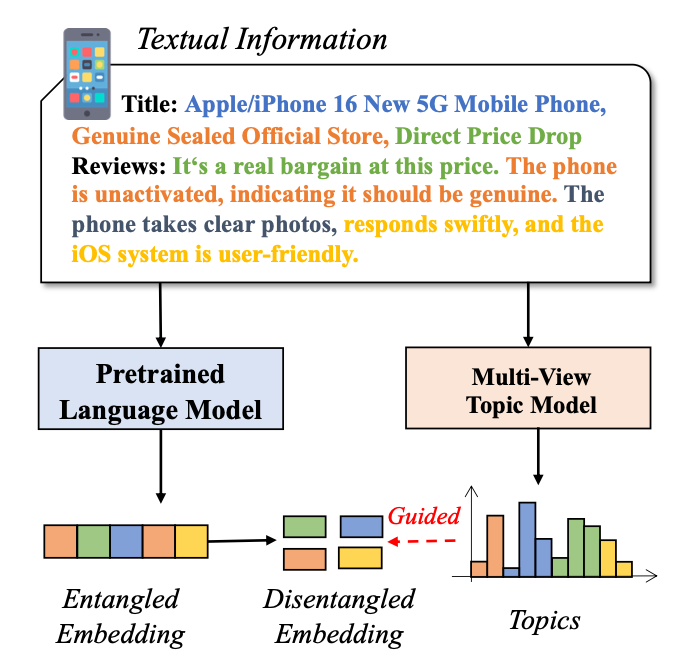
🛠️ The Proposed Framework: MSD-CTR
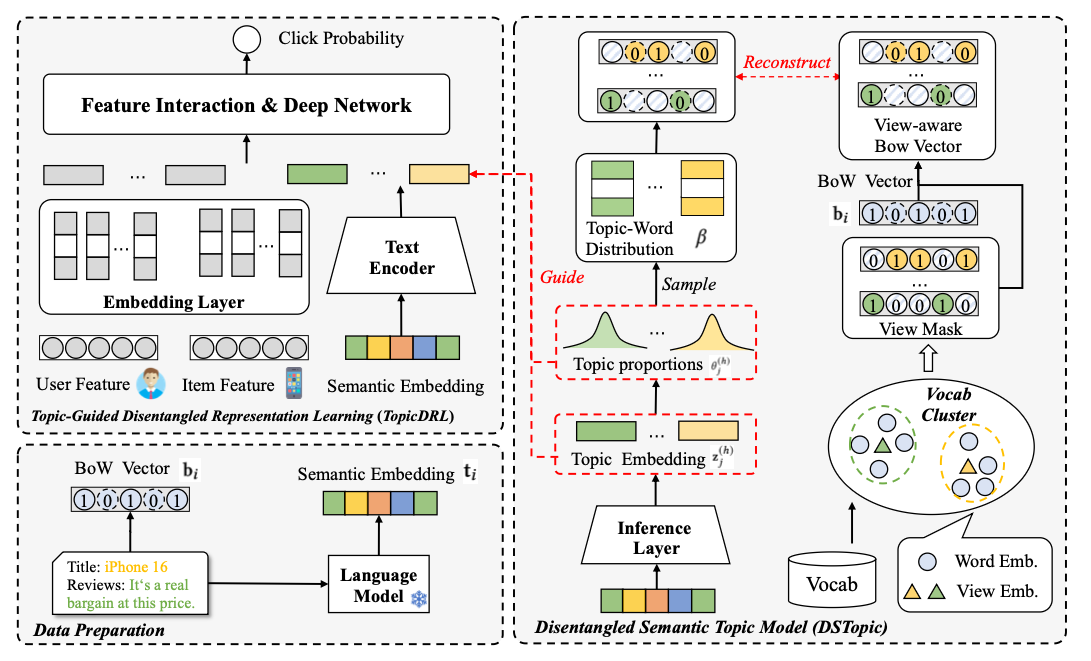
MSD-CTR includes two key components:
1. Disentangled Semantic Topic Model (DSTopic)
- Extracts multi-faceted knowledge from item-related textual descriptions.
- Employs a disentangled multi-view topic model based on Variational Autoencoder (VAE).
- Incorporates a vocabulary clustering module to allocate words to different semantic views.
2. Topic-Guided Disentangled Representation Learning (TopicDRL)
- Learns disentangled semantic embeddings guided by topic structure.
- Uses two losses:
- Individual-level alignment loss
- Intra-view contrastive loss
📊 Experimental Results
We evaluate MSD-CTR on four Amazon datasets:
- Arts & Crafts
- Grocery
- Office Products
- Garden
Metrics:
- AUC
- LogLoss
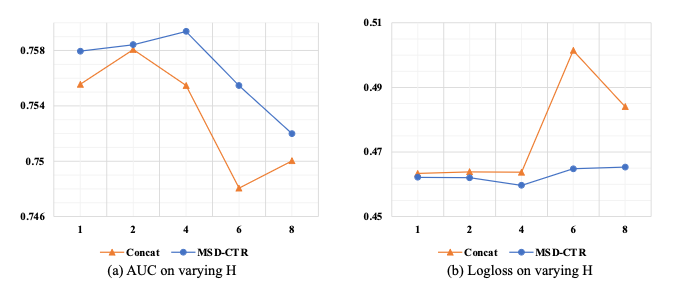
MSD-CTR consistently outperforms strong baselines like DCNv2, DeepFM, CTRL, TIGER, and VQRec.
🔍 Qualitative Insights
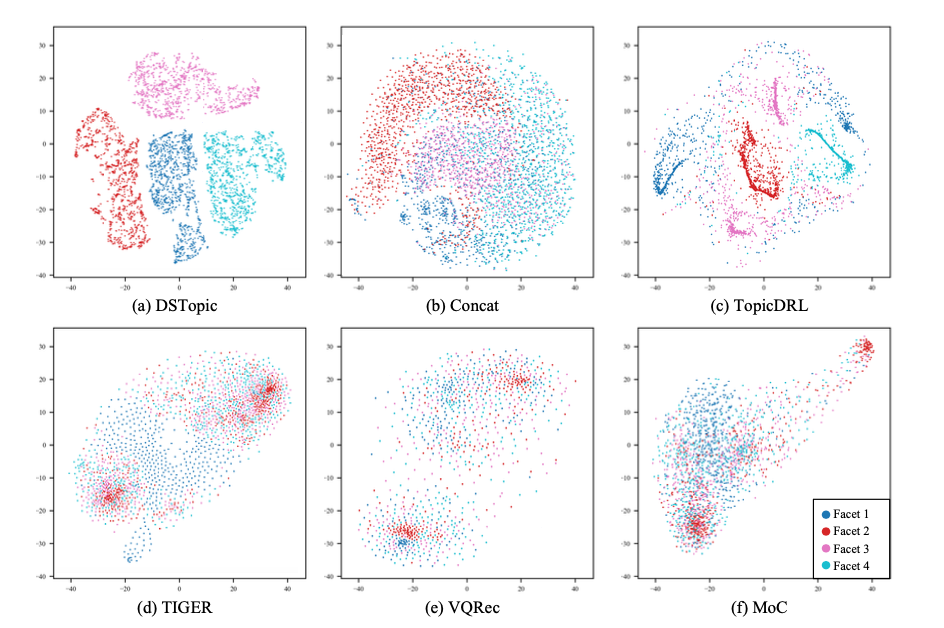
Learned topics are semantically disentangled across views:
- View 0: Healthy snacks
- View 1: Cooking essentials
- View 2: Dietary preferences
- View 3: Customer feedback
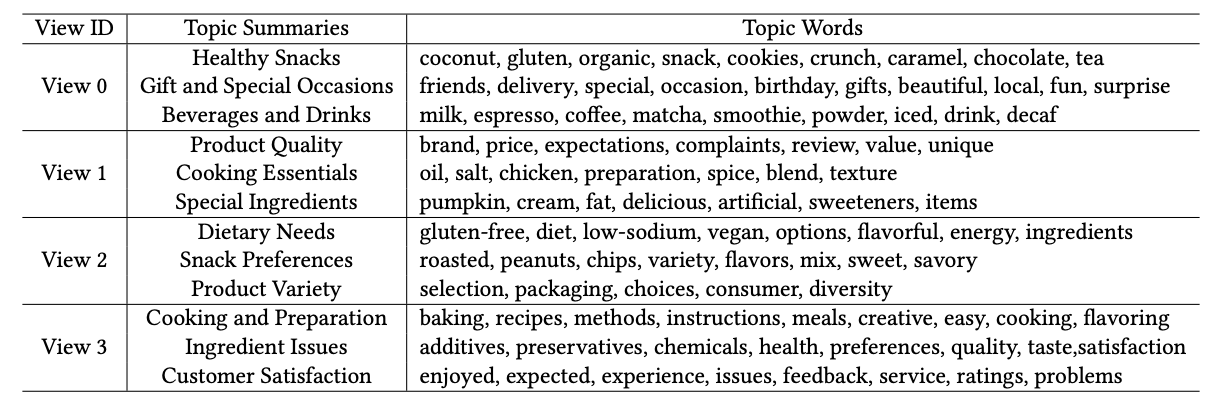
We also use t-SNE to visualize learned embeddings:
🔬 Ablation Studies
We analyze performance drops when removing:
- Topic embeddings
- Alignment losses
MSD-CTR consistently proves its advantage through both metrics and visualization.
📚 Related Work
This work builds on:
- CTR prediction using text/graph/vision
- VAE-based neural topic modeling
- Disentangled representation learning in recommendation
🧾 Conclusion
MSD-CTR shows that disentangling semantic representations leads to significantly better CTR prediction. With its topic-guided learning pipeline and multi-faceted view modeling, it provides a generalizable framework for other recommendation tasks.